What causes cTTP?
Congenital thrombotic thrombocytopenic purpura (cTTP) is caused by autosomal recessive mutations in the ADAMTS13 gene.1,2 Consequently, patients with cTTP either have a severe deficiency (<10% enzyme activity) or complete absence of plasma ADAMTS13, leading to an increased risk of microvascular thrombosis.1-3 The mutations in the ADAMTS13 gene can be frameshift, missense, or nonsense types. So far, over 200 mutations have been described, spread across all 29 exons of the gene.4,5
cTTP was first described in 1960 and, shortly afterwards, a discovery was made that the administration of plasma-containing blood products could be used to treat the resultant thrombocytopenia. This suggested that the deficiency of an unidentified plasma factor was responsible for the disorder.6 Further advances were made in 1982, when extremely large von Willebrand factor (VWF) multimers were found to be associated with chronic relapsing thrombotic thrombocytopenic purpura (TTP). It was believed that TTP patients lacked a factor in their plasma that regulated the size of VWF multimers and prevented microvascular thrombosis.7
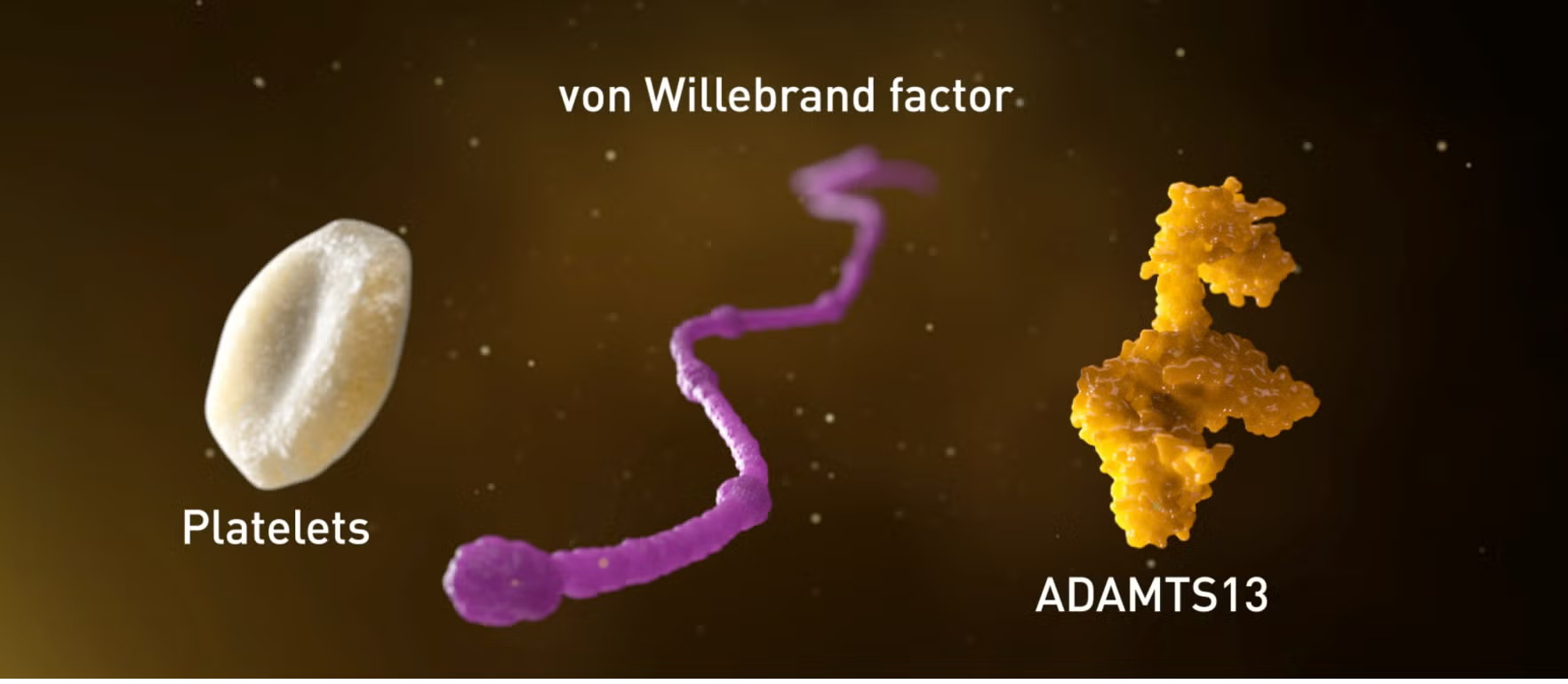
The key breakthrough in TTP pathogenesis occurred more recently, with the discovery of ADAMTS13 enzyme. This plasma protein cleaves VWF, which interacts with platelets to promote blood clotting.7,8 Endothelial cells secrete VWF as ultra-large multimers, and ADAMTS13 gradually reduces the size of these multimers as they circulate in the blood.7 Left unchecked, large, uncleaved VWF multimers can lead to spontaneous platelet adherence and aggregation.2
By regulating the size of VWF multimers, ADAMTS13 plays an important role in haemostasis.2 In its absence, ultra-large VWF multimers facilitate spontaneous microthrombi formation which are responsible for many of the clinical features associated with TTP.8 For example, microthrombi forming in small vessels can lead to destruction of red blood cells, which leads to haemolytic anaemia with fragmented red blood cells (schistocytes).9 Microthrombi can reduce or block normal blood flow and cause acute as well as chronic damage to the patient's organs, such as the heart, kidneys, gastrointestinal tract, and brain.3,9 Platelet levels in circulation can be severely reduced due to capture by microthrombi, leading to thrombocytopenia.9 Ultimately, the discovery of ADAMTS13 has truly transformed our understanding of TTP pathogenesis.7
- Scully M, et al. J Thromb Haemost. 2017;15(2):312-322.
- Kremer Hovinga JA, George JN. N Engl J Med. 2019;381(17):1653-1662.
- Scully M, et al. N Engl J Med. 2024;390(17):1584-1596.
- Alwan F, et al. Blood. 2019;133(15):1644-1651.
- Seidizadeh O, et al. Haemophilia. 2023;29(Suppl 3):7. Abstract OC-01.
- von Krogh AS, et al. Tidsskr Nor Laegeforen. 2016;136(17):1452-1457.
- Sadler JE. Blood. 2017;130(10):1181-1188.
- Rogers HJ, et al. Cleve Clin J Med. 2016;83(8):597 603.
- Kremer Hovinga JA, et al. Nat Rev Dis Primers. 2017;3:17020.
ADAMTS13, A disintegrin and metalloproteinase with thrombospondin motifs 13
cTTP, Congenital thrombotic thrombocytopenic purpura
SmPC, Summary of product characteristics
TTP, Thrombotic thrombocytopenic purpura
VWF, von Willebrand factor