


Image


SAFETY

ADZYNMA is an enzyme replacement therapy (ERT) indicated for the treatment of A disintegrin and metalloproteinase with thrombospondin motifs 13 (ADAMTS13) deficiency in children and adult patients with congenital thrombotic thrombocytopenic purpura (cTTP). ADZYNMA can be used for all age groups.1,*

*ADZYNMA is a purified bivariant human recombinant ADAMTS13 (rADAMTS13) expressed in Chinese Hamster Ovary (CHO) cells using recombinant DNA technology (a mixture of native rADAMTS13 Q23 and variant rADAMTS13 R23 with a controlled range of the two variants ratio), referred to as rADAMTS13.1
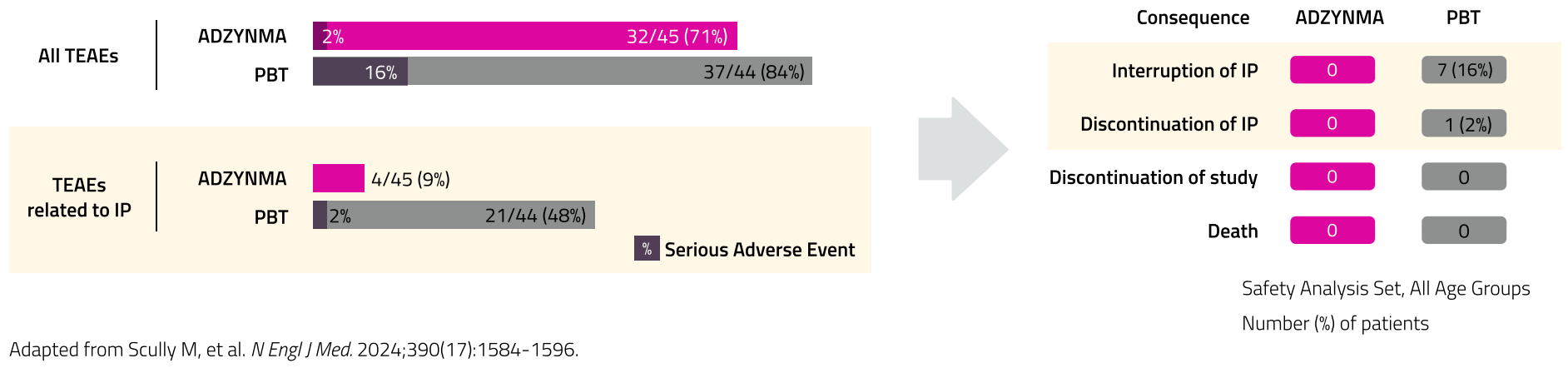
 

The ADZYNMA safety profile in patients with cTTP was demonstrated in a Phase 3, open-label, crossover trial (NCT03393975).2,3 Adverse events occurred in 71% of the patients with recombinant ADAMTS13 and in 84% with standard therapy. Adverse events that were considered by investigators to be related to the trial drug occurred in 9% of the patients with recombinant ADAMTS13 and in 48% with standard therapy. Trial-drug interruption or discontinuation due to adverse events occurred in no patients with recombinant ADAMTS13 and in 8 patients with standard therapy. No neutralizing antibodies developed during recombinant ADAMTS13 treatment.


Summary of Treatment-Emergent Adverse Events (TEAEs)1,2

Image


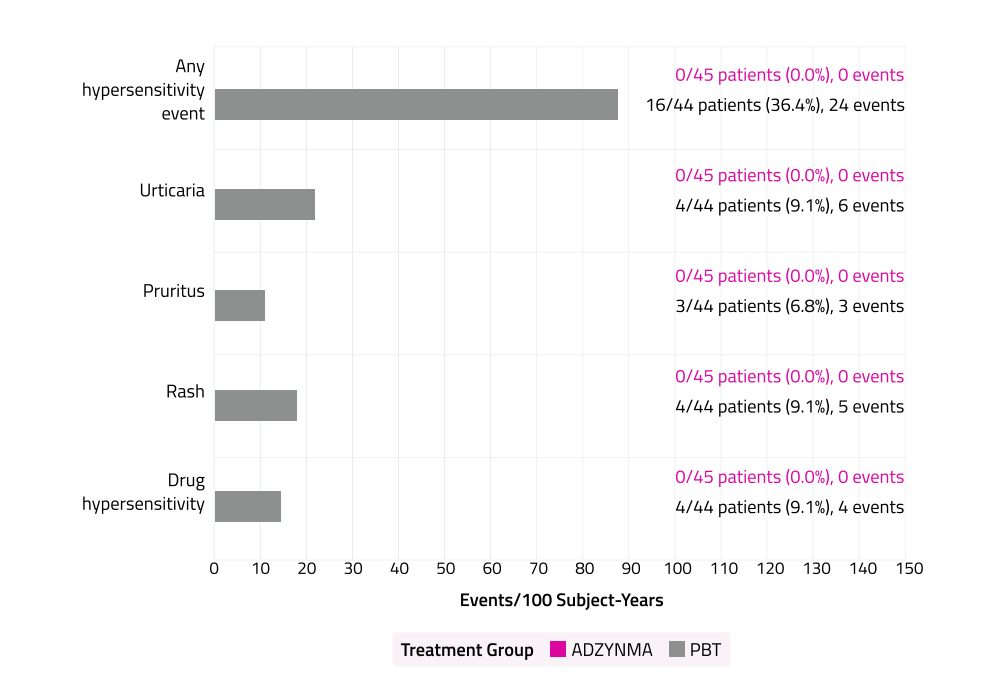
ADZYNMA prophylaxis resulted in fewer hypersensitivity reactions when compared to PBT2
 

Image

Adapted from Scully M, et al. N Engl J Med. 2024;390(17):1584-1596, and Supplementary Appendix.

Image

The ADZYNMA safety profile in patients with cTTP was demonstrated in a Phase 3, open-label, crossover trial (NCT03393975). 2,3 Adverse events occurred in 71% of the patients with ADZYNMA and in 84% with plasma-based therapy in periods 1 and 2 of the trial.2

Image

In a Phase 3, open-label, crossover trial (NCT03393975), drug-related TEAEs were 5x more common among patients who received plasma-based therapy vs those who received ADZYNMA (~48% vs ~9%, respectively).2

Image


In a Phase 3, open-label, crossover trial (NCT03393975), no ADZYNMA-related serious adverse events were reported.2

Image


In Periods 1 & 2, ADZYNMA prophylaxis resulted in 0 hypersensitivity adverse event (n=45) vs 24 events in 16 patients in the plasma-based therapies group (n=44).2


ADZYNMA is contraindicated in patients with life-threatening hypersensitivity to ADZYNMA or to any of its excipients.1,*

Image

Hypersensitivity:1

Allergic-type hypersensitivity including anaphylactic reactions may occur with ADZYNMA treatment. Patients should be informed of the early signs of hypersensitivity reactions including but not limited to tachycardia, tightness of the chest, wheezing and/or acute respiratory distress, hypotension, generalised urticaria, pruritus, rhinoconjunctivitis, angioedema, lethargy, nausea, vomiting, paraesthesia, restlessness, and may progress to anaphylactic shock. If signs and symptoms of severe allergic reactions occur, immediately discontinue administration of ADZYNMA and provide appropriate supportive care.

Image

Immunogenicity:1

As with all therapeutic proteins, there is a potential for immunogenicity with ADZYNMA treatment. Patients treated with ADZYNMA may develop neutralising antibodies to the therapy which could potentially result in a decreased or lack of response. If such antibodies are suspected and there is a lack of efficacy, consider other therapeutic strategies.

*List of excipients. Powder: Sodium chloride, Calcium chloride dihydrate, L Histidine, Mannitol, Sucrose, Polysorbate 80 (E433). Solvent: Water for injections.1


Adverse reactions in the ADZYNMA clinical trials1

In a Phase 3, open label, crossover trial (NCT03393975), no ADZYNMA related serious adverse events were reported.2


The safety profile of ADZYNMA was evaluated in a global Phase 3, prospective, randomised, controlled, open-label, multicentre, twoperiod crossover study. Further evaluation was performed in a long-term continuation study for patients who completed the Phase 3 Study.1


The most common adverse reactions reported in clinical studies were headache (31.5%), diarrhoea (17.8%), dizziness (16.4%), upper respiratory tract infection (15.1%), nausea (13.7%), and migraine (11%).1
 

MEDDRA SYSTEM ORGAN CLASS (SOC) ADVERSE REACTION BY PREFERRED TERM (PT) FREQUENCY CATEGORY BY SUBJECT*

Infections and Infestations

Upper respiratory tract infection

Very common

Blood and Lymphatic System Disorders

Thrombocytosis

Common

Nervous System Disorders

Headache

Migraine

Dizziness

Somnolence

Very common

Very common

Very common

Common

Gastrointestinal Disorders

Diarrhoea

Nausea

Constipation

Abdominal distension

Very common

Very common

Common

Common

General Disorders and Administration Site Conditions

Asthenia

Feeling hot

Common

Common

Investigations

ADAMTS13 activity abnormal

Common

Image


No patients receiving ADZYNMA had adverse events leading to treatment discontinuation or interruption.2

* Adverse reactions are listed above by MedDRA system organ class and by frequency. Frequencies are defined as follows: very common (≥ 1/10); common (≥ 1/100 to < 1/10); uncommon (≥ 1/1 000 to < 1/100); rare (≥ 1/10 000 to < 1/1 000); very rare (< 1/10 000); not known (cannot be estimated from the available data). Within each System Organ Class (SOC), ADRs are presented in order of decreasing frequency. Within each frequency grouping, ADRs are presented in order of decreasing seriousness.1


References and acronyms

  1. ADZYNMA (rADAMTS13) EU Summary of Product Characteristics. Last approved version.
  2. Scully M, et al. N Engl J Med. 2024;390(17):1584-1596.
  3. A Study of BAX 930 in Children, Teenagers, and Adults Born With Thrombotic Thrombocytopenic Purpura (TTP): NCT03393975. Updated 4th June 2024. Accessed February 2025. Available at: https://clinicaltrials.gov/study/NCT03393975
  4. Scully M, et al. N Engl J Med. 2024;390(17):1584-1596. Supplementary appendix.


ADAMTS13, A disintegrin and metalloproteinase with thrombospondin motifs 13
ADR, Adverse drug reaction
cTTP, Congenital thrombotic thrombocytopenic purpura
CHO, Chinese hamster ovary
DNA, Deoxyribonucleic acid
ERT, Enzyme replacement therapy
IP, Investigational product
PBT, Plasma based therapy
PT, Preferred term
rADAMTS13, Recombinant ADAMTS13
SmPC, Summary of product characteristics
SOC, System organ class
TEAE, Treatment emergent adverse event
TTP, Thrombotic thrombocytopenic purpura
vs, Versus

smpc

price

Image


Need further information?

▼ This medicinal product is subject to additional monitoring. This will allow quick identification of new safety information. Healthcare professionals are asked to report any suspected adverse reactions. See section 4.8 of the SmPC for how to report adverse reactions.

C-APROM/BE/ADZ/0005 November 2025