Image


EFFICACY

ADZYNMA is an enzyme replacement therapy (ERT) indicated for the treatment of ADAMTS13 deficiency in children and adult patients with congenital thrombotic thrombocytopenic purpura (cTTP). ADZYNMA can be used for all age groups. 1,*

*ADZYNMA is a purified bivariant human recombinant “A disintegrin and metalloproteinase with thrombospondin motifs 13” (rADAMTS13) expressed in Chinese Hamster Ovary (CHO) cells using recombinant DNA technology (a mixture of native rADAMTS13 Q23 and variant rADAMTS13 R23 with a controlled range of the two variants ratio), referred to as rADAMTS131


ADZYNMA prophylaxis

Primary endpoint: ADZYNMA prophylaxis for a median of 13.3 months was associated with zero acute TTP events and fewer sub-acute TTP events compared to treatment with plasma-based therapies.2,3,*,†

*An acute TTP event was defined as a decrease in the platelet count by at least 50% from baseline or to less than 100,000 per μL and an elevation of the lactate dehydrogenase (LDH) level to more than 2 times the baseline value or more than 2 times the upper limit of the normal range (ULN).2,3

† Subacute events were two or more of the following (including ≥1 laboratory measurement): a decrease in the platelet count by at least 25% from baseline or to less than 150,000 per μL, an increase in the lactate dehydrogenase (LDH) level to more than 1.5 times the baseline value or more than 1.5 times the upper limit of the normal range (ULN), or organ-specific signs or symptoms of TTP.2,3


ADZYNMA prophylaxis resulted in higher mean platelet counts over time vs plasma-based therapies3

Image

Adapted from Scully M, et al. N Engl J Med. 2024;390(17):1584-1596.

.

.

.

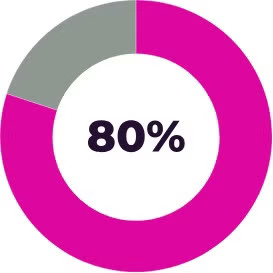
80% of patients had higher mean platelet counts with ADZYNMA than with plasma-based therapies3

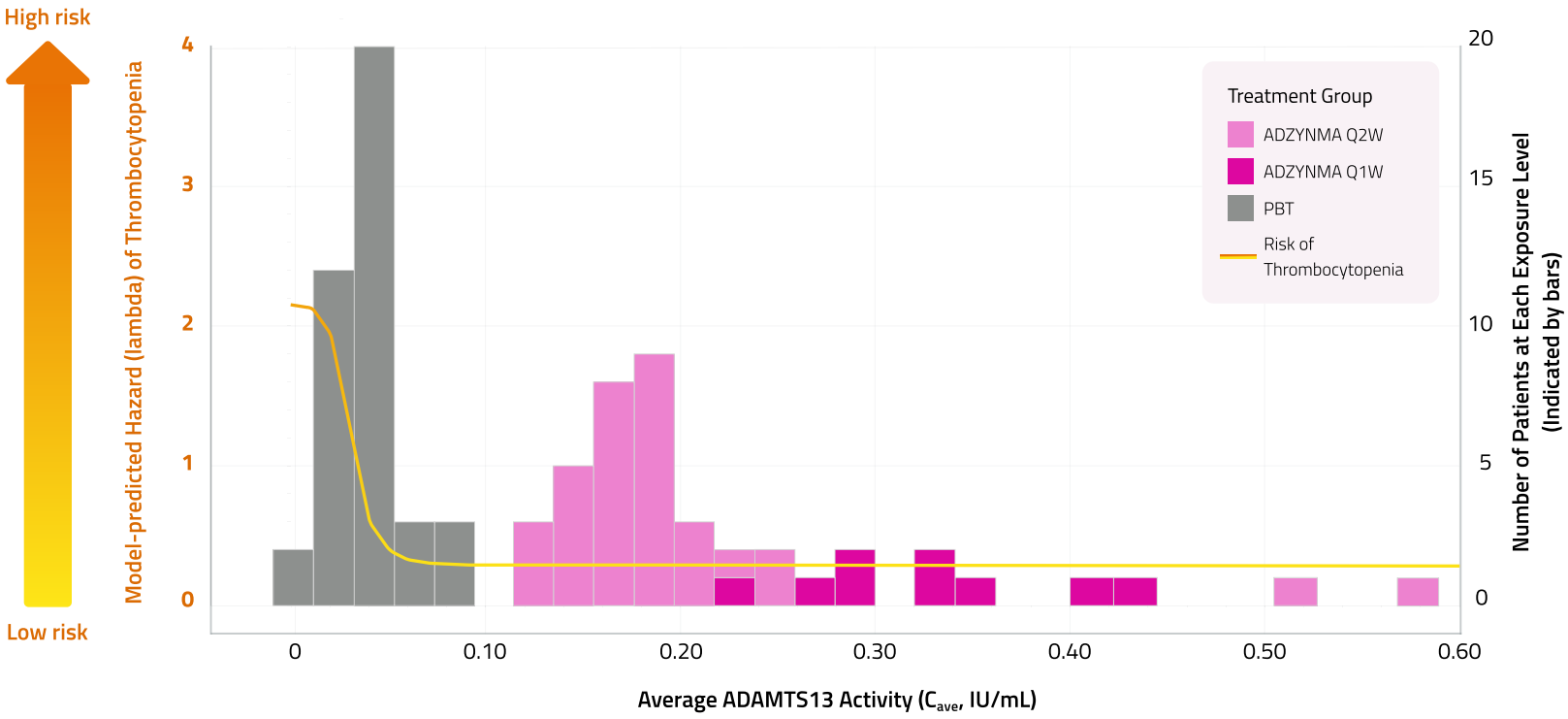
Higher protection against thrombocytopenia achieved with ADZYNMA vs plasma-based therapies4

Image

Adapted from Blood, Vol 142, Patel M, et al. Population Pharmacokinetics and Exposure-Response Analyzes to Demonstrate the Link of Causality between ADAMTS13 and the Clinical Effects of Recombinant ADAMTS13 Compared to Plasma-Based Therapies, Page 1260, Copyright 2023, with permission from ASH.

At the recommended dose, ADZYNMA treatment is predicted to achieve ADAMTS13 levels expected to provide high protection against thrombocytopenia in >95% of cTTP patients, whereas plasma-based therapies are predicted to confer similar levels in only ~10% of cTTP patients.4,*

*Exposure-response model simulations suggested that >95% of patients treated with ADZYNMA are predicted to have plasma Cave ADAMTS13 >0.13 IU/mL (equivalent to 13% activity), corresponding to a high probability (>70%) of protection against thrombocytopenia.⁴


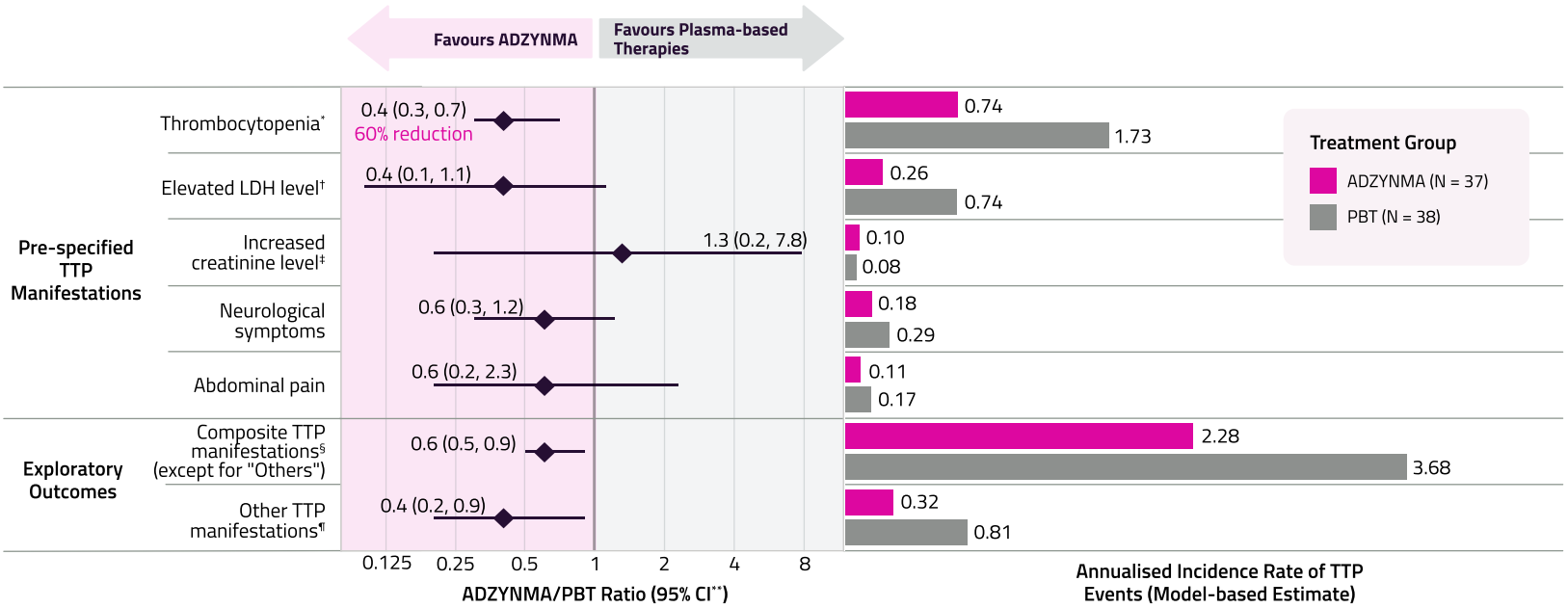
Prophylactic treatment with ADZYNMA in the Phase 3, open-label, crossover trial (NCT03393975) resulted in a lower annualised incidence rate of composite TTP manifestations (≥1 of the following: thrombocytopenia, elevated lactate dehydrogenase (LDH) level, increased creatinine level, neurological symptoms, or abdominal pain) vs plasma-based therapy.3,5

Image

* Thrombocytopenia was defined as a decrease in the platelet count by ≥25% from baseline or to <150,000 per microlitre
† An elevated lactate dehydrogenase (LDH) level was defined as an increase to more than 1.5x the baseline value or more than 1.5x the upper limit of the normal range
‡ Increase in serum creatinine >1.5x baseline
§ The number of composite cTTP manifestations, an exploratory outcome measure, was defined as the occurrence of one or more of the following pre-specified isolated TTP manifestations: thrombocytopenia, elevated LDH level, increased creatinine level, neurologic symptoms or abdominal pain, excluding the "Others" category
¶ The ad hoc analysis of other TTP manifestations was intended to capture all TTP-related events reported by investigators that were not pre-specified TTP manifestations (e.g. fatigue or nausea)
** The widths of the confidence intervals have not been adjusted for multiplicity and should not be used to infer definitive treatment effects


Adapted from Scully M, et al. N Engl J Med. 2024;390(17):1584-1596.


In the Phase 3 open-label study:

Image


Thrombocytopenia was the most frequently observed TTP manifestation (annualised event rate, 0.74 with ADZYNMA and 1.73 with plasma-based therapy).3

Image


No acute TTP event occurred during prophylaxis with ADZYNMA, whereas 1 patient had an acute TTP event during prophylaxis with plasma-based therapy (mean annualised event rate, 0.05).3


ADZYNMA pharmacology

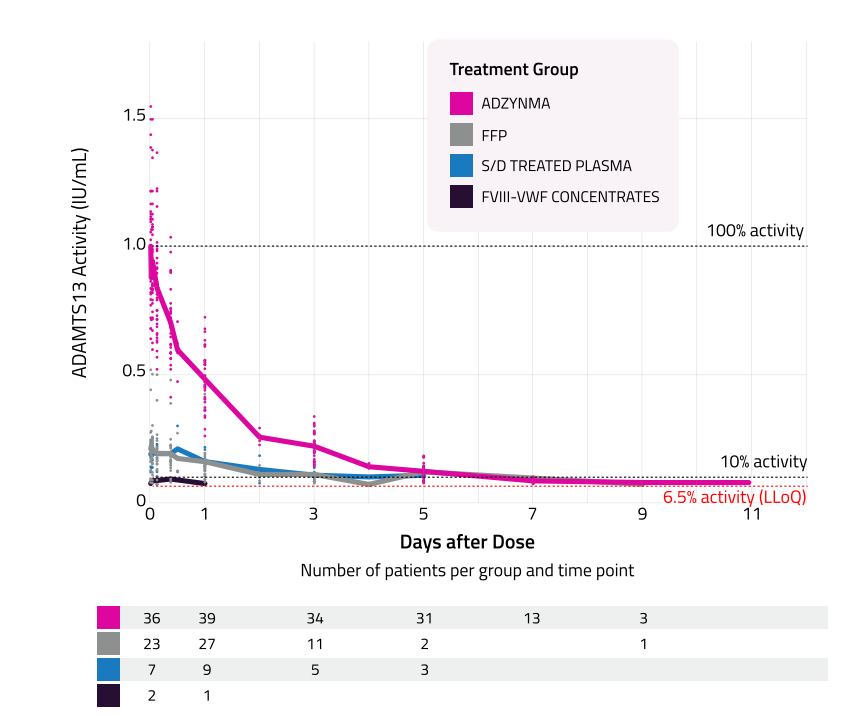
ADZYNMA intravenous (IV) administration at 40 IU/kg resulted in approximately greater than 5-fold higher ADAMTS13 activity exposures (maximum concentration [Cmax], area under the curve [AUC], and duration above 10% ADAMTS13 activity) and lower variability when compared to plasma-based therapies.1,*

Image

Adapted from Scully M, et al. N Engl J Med. 2024;390(17):1584-1596.

Image


In a Phase 3, open-label, crossover trial (NCT03393975), the mean time with ADAMTS13 activity of ≥10% was 5.2 days after ADZYNMA administration vs. 1.7 days after plasma-based therapy.3

Image


The mean maximum ADAMTS13 activity after ADZYNMA treatment was 101%, as compared with 19% after plasma based therapy.3

Image

The prophylactic dose of ADZYNMA is 40 IU per kg of body weight, administered once every other week. The prophylaxis dosing frequency may be adjusted to 40 IU/kg of body weight once weekly based on clinical response.1

Image

Prophylactic treatment with ADZYNMA in the Phase 3, open-label, crossover trial (NCT03393975) resulted in a lower annualised incidence rate of composite cTTP manifestations (≥1 of the following: thrombocytopenia, elevated LDH level, increased creatinine level, neurological symptoms, or abdominal pain) vs plasma-based therapy.3,5

*The pharmacokinetic (PK) profile of ADZYNMA was determined based on clinical trial ADAMTS13 activity data analyses. Following single-dose IV administration of ADZYNMA at 5 IU/kg, 20 IU/kg, and 40 IU/kg to adults and adolescents, dose-related increases in individual ADAMTS13 activity were observed and reached a maximum at approximately 1 hour post-administration or earlier.1


ADZYNMA on-demand

ADZYNMA can be used prophylactically, and on-demand, to treat congenital TTP in children and adults.1

Image

After on-demand treatment of acute TTP events (7 events in 6 patients, including 1 event during prophylaxis with plasma-based therapy), improved platelet counts were accompanied by a mean ADAMTS13 activity, measured 1 hour after infusion, of 1.14 IU/mL (range, 0.87 to 1.41) with ADZYNMA and 0.18 IU/mL (range, 0.08 to 0.24) with plasmabased therapy.3

Image

ADZYNMA IV administration at 40 IU/kg resulted in approximately greater than 5-fold higher ADAMTS13 activity exposures (Cmax, AUC, and duration above 10% ADAMTS13 activity) and lower variability when compared to plasma-based therapies.1


References and acronyms

  1. ADZYNMA (rADAMTS13) EU Summary of Product Characteristics. Last approved version.
  2. Scully M, et al. N Engl J Med. 2024;390(17):1584-1596. Supplementary appendix.
  3. Scully M, et al. N Engl J Med. 2024;390(17):1584-1596.
  4. Patel M, et al. Blood. 2023;142(Suppl 1):1260.
  5. A Study of BAX 930 in Children, Teenagers, and Adults Born With Thrombotic Thrombocytopenic Purpura (TTP): NCT03393975. Updated 4th June 2024. Accessed February 2025. Available at: https://clinicaltrials.gov/study/NCT03393975


ADAMTS13, A disintegrin and metalloproteinase with thrombospondin motifs 13
AUC, Area under the plasma concentration-time curve
Cave, Average plasma concentration at steady-state
CI, Confidence interval
Cmax, Maximum plasma concentration
cTTP, Congenital thrombotic thrombocytopenic purpura
CHO, Chinese hamster ovary
DNA, Deoxyribonucleic acid
ERT, Enzyme replacement therapy
FFP, Fresh frozen plasma
FVIII, Factor VIII
IU, International unit
IV, Intravenous
LDH, Lactate dehydrogenase
LLoQ, Lower limit of quantification
PBT, Plasma-based therapy
PK, Pharmacokinetic
Q1W, Once weekly
Q2W, Once every two weeks 
rADAMTS13, Recombinant ADAMTS13
S/D, Solvent detergent
SmPC, Summary of product characteristics
TTP, Thrombotic thrombocytopenic purpura
ULN, Upper limit of normal
vs, Versus


smpc

price

Image


Need further information?

▼ This medicinal product is subject to additional monitoring. This will allow quick identification of new safety information. Healthcare professionals are asked to report any suspected adverse reactions. See section 4.8 of the SmPC for how to report adverse reactions.

C-APROM/BE/ADZ/0004 November 2025